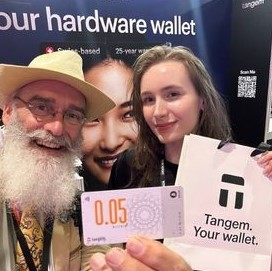
The Tangem Wallet takes a fundamentally different approach to hardware wallet design: a credit-card-sized device that stores your private keys in a secure chip, designed to be carried in your wallet and used with your phone’s NFC interface. At $47 for a single card (or $94 for a two-card backup set), the Tangem is the most affordable hardware wallet from a major manufacturer, and its card form factor addresses the portability problem that plagues traditional hardware wallet designs.
First Impressions: Build Quality and Design
The Tangem card arrives in minimal packaging — a single card roughly the size of a standard credit card (85.6 x 53.98 x 0.8mm). The card contains a secure chip (EAL6+ certified) embedded in the PVC body, with no display or buttons. Using the card requires the Tangem app on your NFC-capable smartphone.
The card is surprisingly durable — the secure chip is rated for 100,000 NFC interactions and the PVC body can survive being washed in a washing machine (though we do not recommend testing this). The card has no battery — it draws power from the NFC field generated by your phone during each interaction.
Unlike traditional hardware wallets with buttons and displays, the Tangem card is a pure security token: it stores private keys and performs cryptographic operations, but all user interaction happens through the app interface on your phone.
Security Architecture
The Tangem uses an EAL6+ certified secure chip for private key storage. This certification level is higher than most consumer hardware wallets (Ledger uses EAL5+, some competitors use EAL5), making the Tangem’s security architecture unusually strong for its price point.
The secure chip generates and stores the 24-word recovery phrase on the card itself. The seed phrase is generated using the chip’s true random number generator and never leaves the chip. The Tangem app cannot access the seed phrase — it can only request the chip to sign transactions that the app presents.
Transaction signing happens through NFC: hold the card against your phone’s NFC reader. The app presents the transaction details on screen — verify the receiving address and amount on your phone (not on a dedicated device screen). If the details match your intention, confirm in the app. The secure chip signs the transaction via NFC, and the app broadcasts it to the network.
This architecture means private keys are never exposed to your phone’s operating system, even during signing. A compromised phone cannot extract the private keys from the Tangem card — it can only request specific transactions to be signed, and the chip will only sign transactions that match what the app displays.
Setup Process
Setting up the Tangem Wallet involves installing the Tangem app, tapping your card against your phone to initialize the secure chip, writing down your 24-word recovery phrase, and ordering a backup card if desired. The process is faster than traditional hardware wallet setup — approximately 10-15 minutes.
The backup card is essential: if you lose your primary Tangem card, the backup card can restore access to your funds. The backup card should be stored in a different location from your primary card — if both are lost or stolen, your funds may be unrecoverable.
Supported Cryptocurrencies
The Tangem Wallet supports Bitcoin, Ethereum, and approximately 30 other cryptocurrencies including all major ERC-20 tokens. The coin support is adequate for most retail users but less comprehensive than Ledger or Trezor.
The app also supports the ability to create multiple wallets on a single card — useful for separating different holdings (personal vs business, short-term vs long-term) without requiring multiple physical cards.
Comparison with Competitors
vs Ledger Nano S Plus: The Ledger has a secure element (EAL5+) and supports more coins. The Tangem has a higher security certification (EAL6+ vs EAL5+) and a far more portable form factor. The Ledger requires USB connection; the Tangem uses NFC. For users who prioritize portability, the Tangem wins. For users who need maximum coin support, the Ledger is better.
vs Coldcard Mk5: Both are Bitcoin-focused devices with strong security. The Coldcard has air-gap architecture with QR codes; the Tangem uses NFC. The Coldcard has a display for transaction verification; the Tangem relies on your phone screen. The Coldcard is a traditional hardware wallet with buttons and display; the Tangem is a card with no user interface of its own.
vs Trezor Model One: Both are budget options ($79 vs $47). The Trezor has open-source firmware and supports more coins; the Tangem has stronger security certification (EAL6+ vs no secure element on Trezor) and a far more portable form factor.
Pros and Cons
Pros:
- EAL6+ certified secure chip — higher than most competitors
- Card form factor fits in any wallet — maximum portability
- Most affordable major hardware wallet at $47
- No battery required — draws power from NFC field
- Can store multiple wallets on one card
- App-free transaction verification option (view-only wallet)
Cons:
- Transaction verification depends on phone screen — not a dedicated device display
- NFC range limits use cases (cannot use with desktop without NFC reader)
- Card form factor means no physical buttons or display for direct device verification
- Backup card required for full security — adds to total cost ($94 vs $47)
- Coin support less comprehensive than Ledger
Is the Tangem Wallet Right for You?
The Tangem Wallet is ideal for users who prioritize portability above all else — people who want the security of a hardware wallet without the burden of carrying a separate device. If you always have your phone with you (and who doesn’t), the Tangem is always in your wallet, always available.
The security architecture is strong (EAL6+), and the NFC signing process protects private keys from phone-based attacks. The main limitation is transaction verification: you rely on your phone screen rather than a dedicated device display. For small transactions, this is acceptable; for large transactions, some users may prefer a device with its own screen.
For most users, the Tangem represents the best combination of security, portability, and affordability in the current market — and at $47, it is the most accessible entry point to serious cryptocurrency security.
Shop Tangem: Buy Tangem Wallet at Tangem.io
This article is part of our Hardware Wallet Security Cluster — the most comprehensive security resource online. → Read the Full Security Guide → Most Secure Wallets Ranking